Keep Your Job Site Running All Winter
No water or sewer hookups to freeze. Stahla's insulated, heated Water Box, Waste Box, and Complete Box give your office trailer running toilets, sinks, and showers with no utilities on site. Warm water too, where the trailer has its own water heater.
Tanks, pumps, and a heater inside one insulated box, set beside the trailer, refilled and pumped out on a weekly route. Here is how it works.
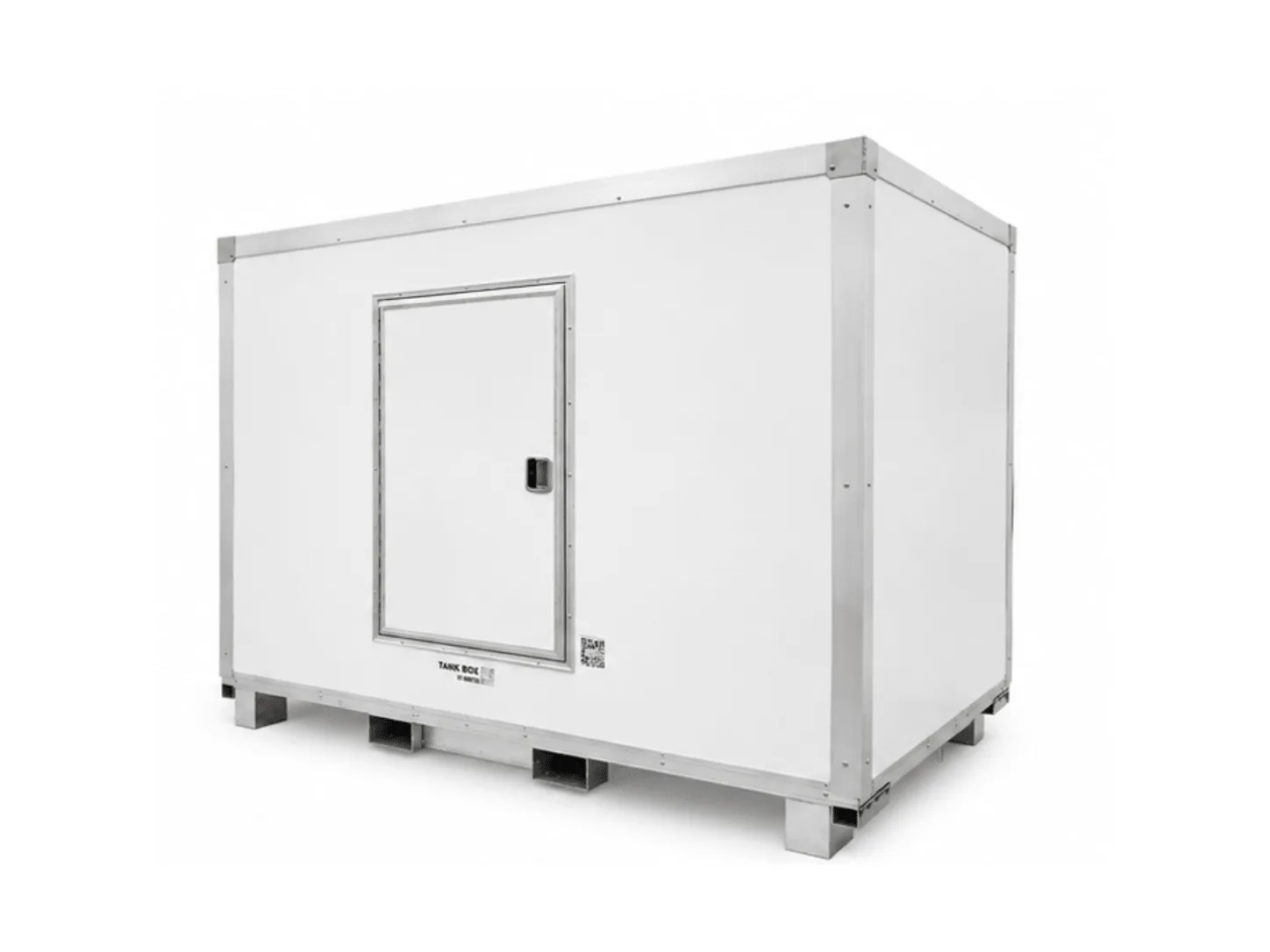
No trenching or permanent plumbing
The box sits beside the trailer. Hoses and a short drain line, nothing in the ground.
No utility hookups
No city water tap, no sewer connection. Runs on one dedicated 120V / 20A circuit.
No utility permits to wait on
Nothing to connect means no water or sewer tap permits holding up the trailer.
Built for freezing conditions
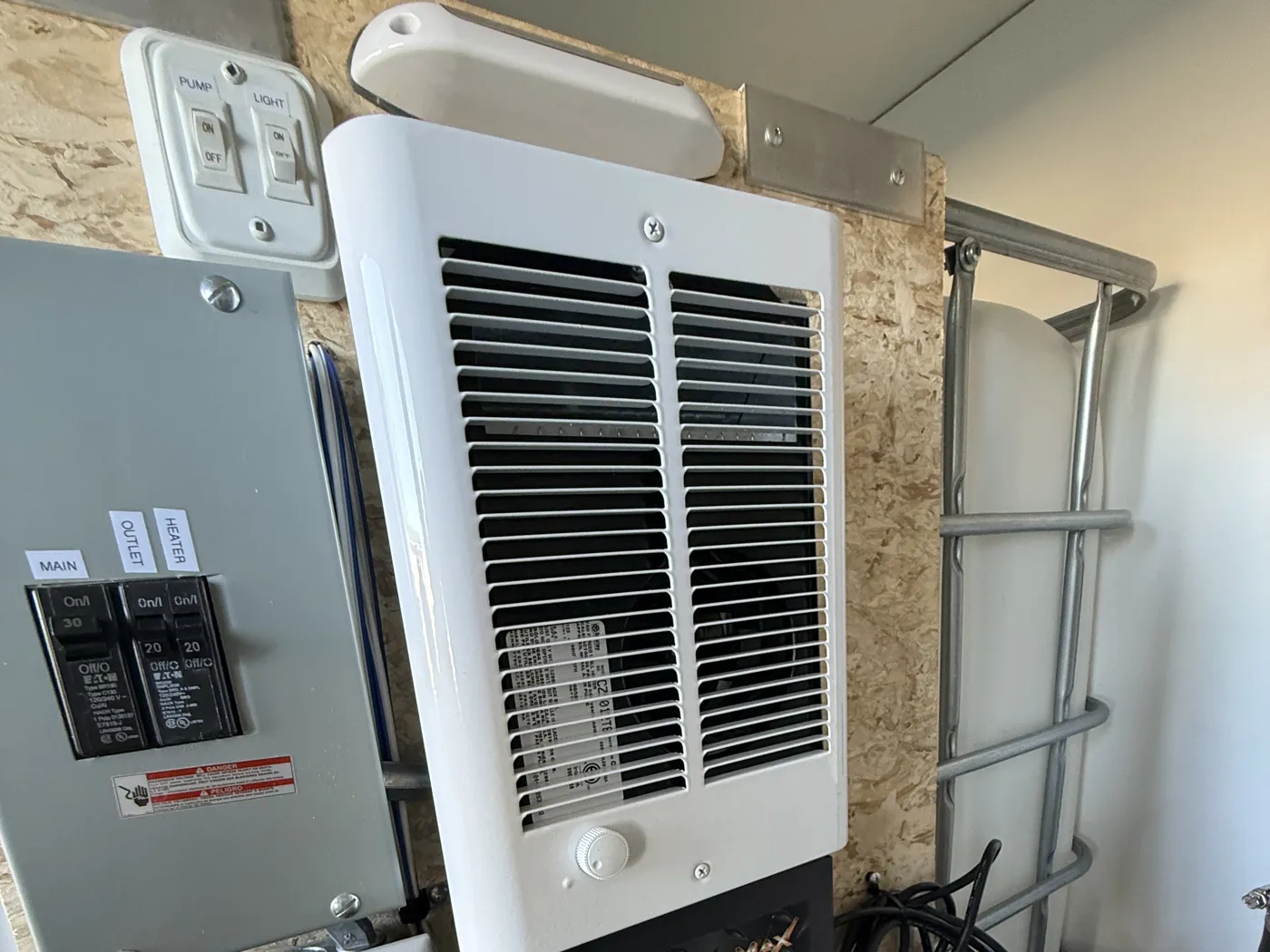
Tanks and pumps inside an insulated box with a 1,000W heater. Heated hose and heat-traced drain line to the trailer.
Delivered, connected, and serviced
Set by forklift, plumbed and powered by our crew, refilled and pumped out on a weekly route.
One turn-key vendor
Equipment and servicing on one invoice. Add restroom or shower trailers to the same system.
How It Works
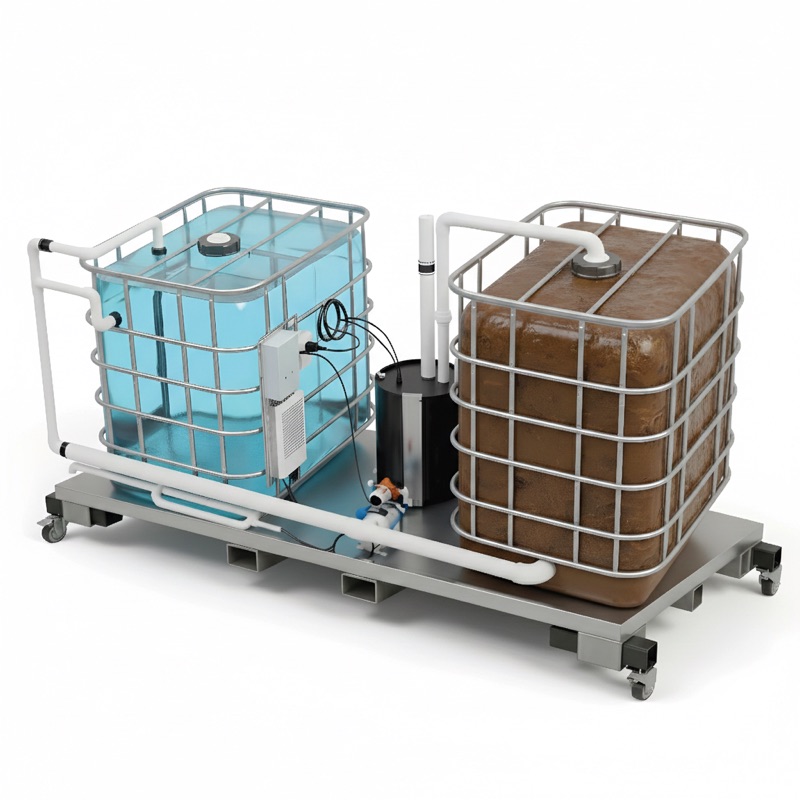
The box sits next to your office trailer. Fresh water is pumped out to the trailer. Waste drains back to the box and is pumped up into a sealed tank. Everything that can freeze is inside an insulated, heated enclosure.
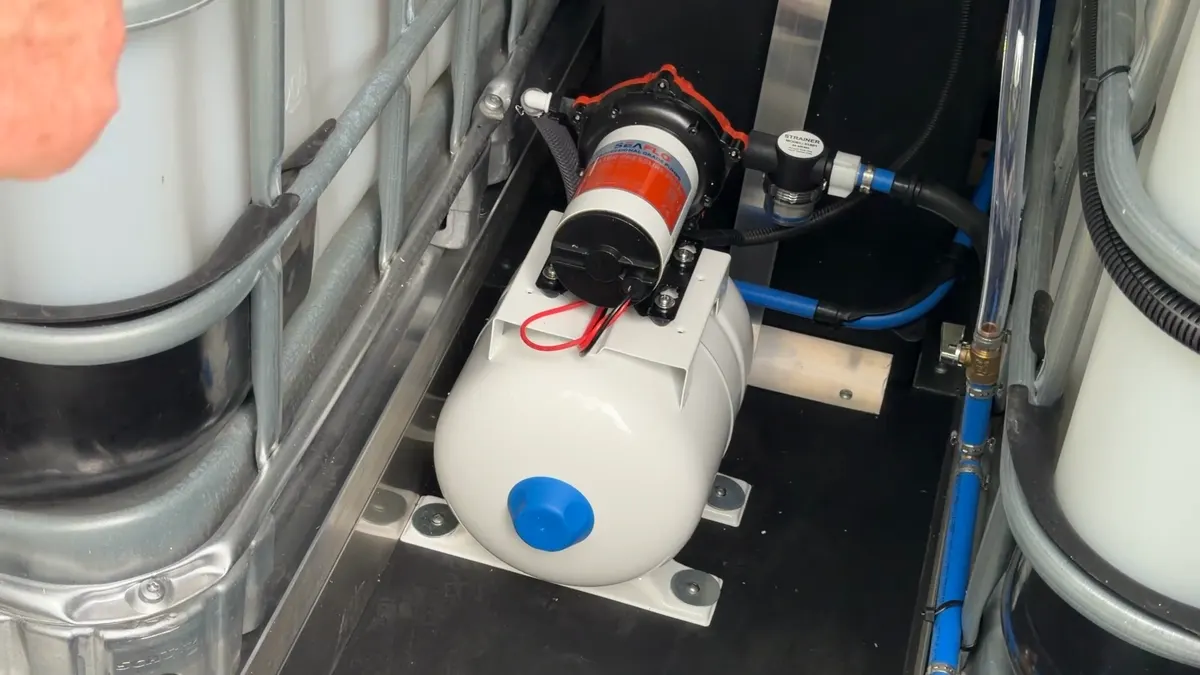
- 1 Fresh water tank. Stored inside the insulated, heated box — not in an open tote in the weather.
- 2 Water pump + pressure tank. Built-in 12V pump and pressure tank push water through a heated hose to the trailer. Sinks and toilets work like they are on city water.
- 3 Waste line. The trailer drain runs to the box through a 3-inch line, sloped 1/4 inch per foot, wrapped in heat cable and insulation for winter.
- 4 Sump basin + sewage pump. Waste enters a sump basin inside the box. A sewage pump lifts it through a check valve into the waste tank. High-level alarms warn before anything backs up.
- 5 Waste tank. Sealed and vented inside the box. Out of sight, locked, and above freezing.
- 6 1,000W heater. Electric heater keeps the inside of the box above freezing. Runs on one dedicated 120V / 20A circuit along with the pumps.
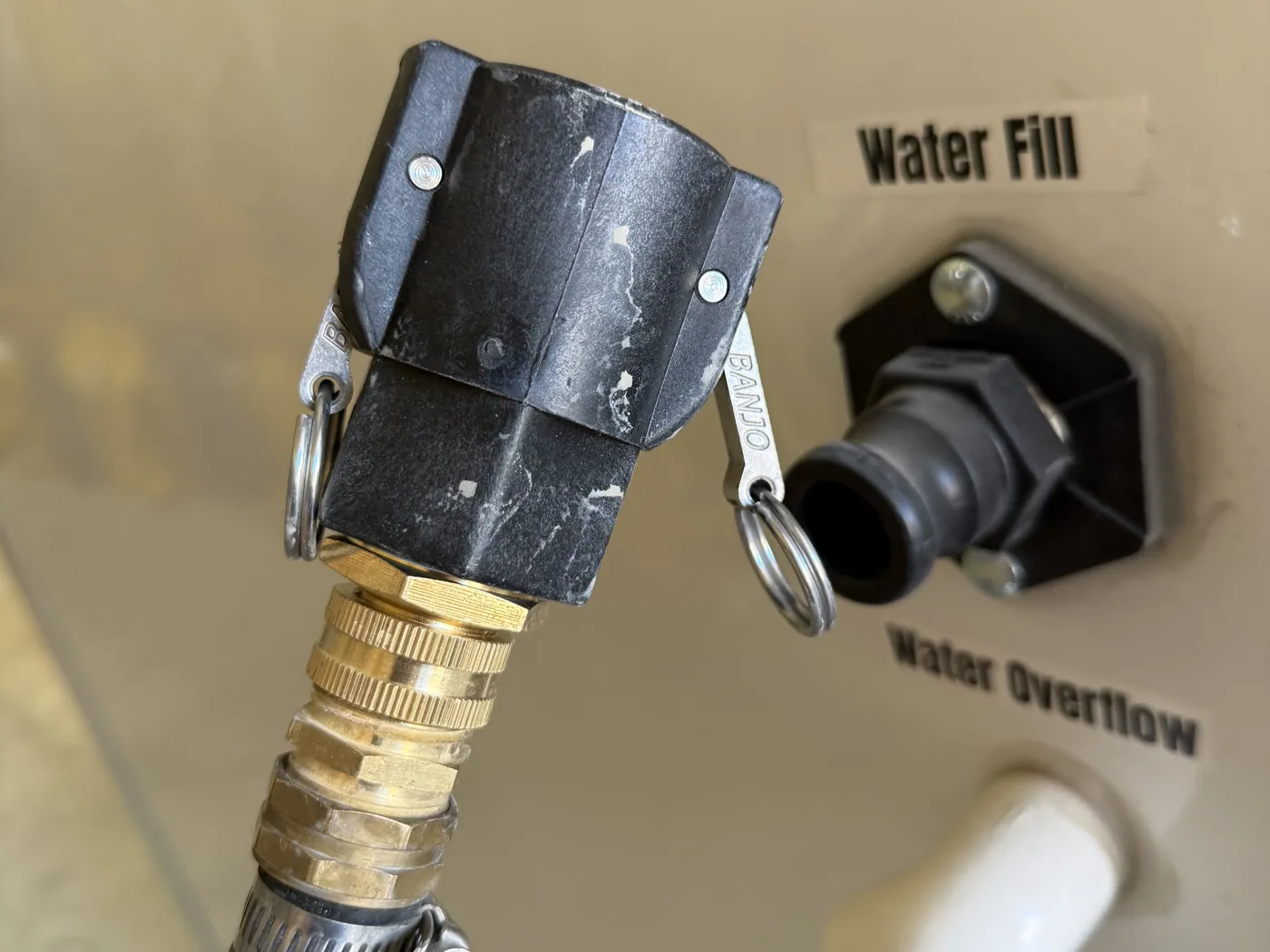
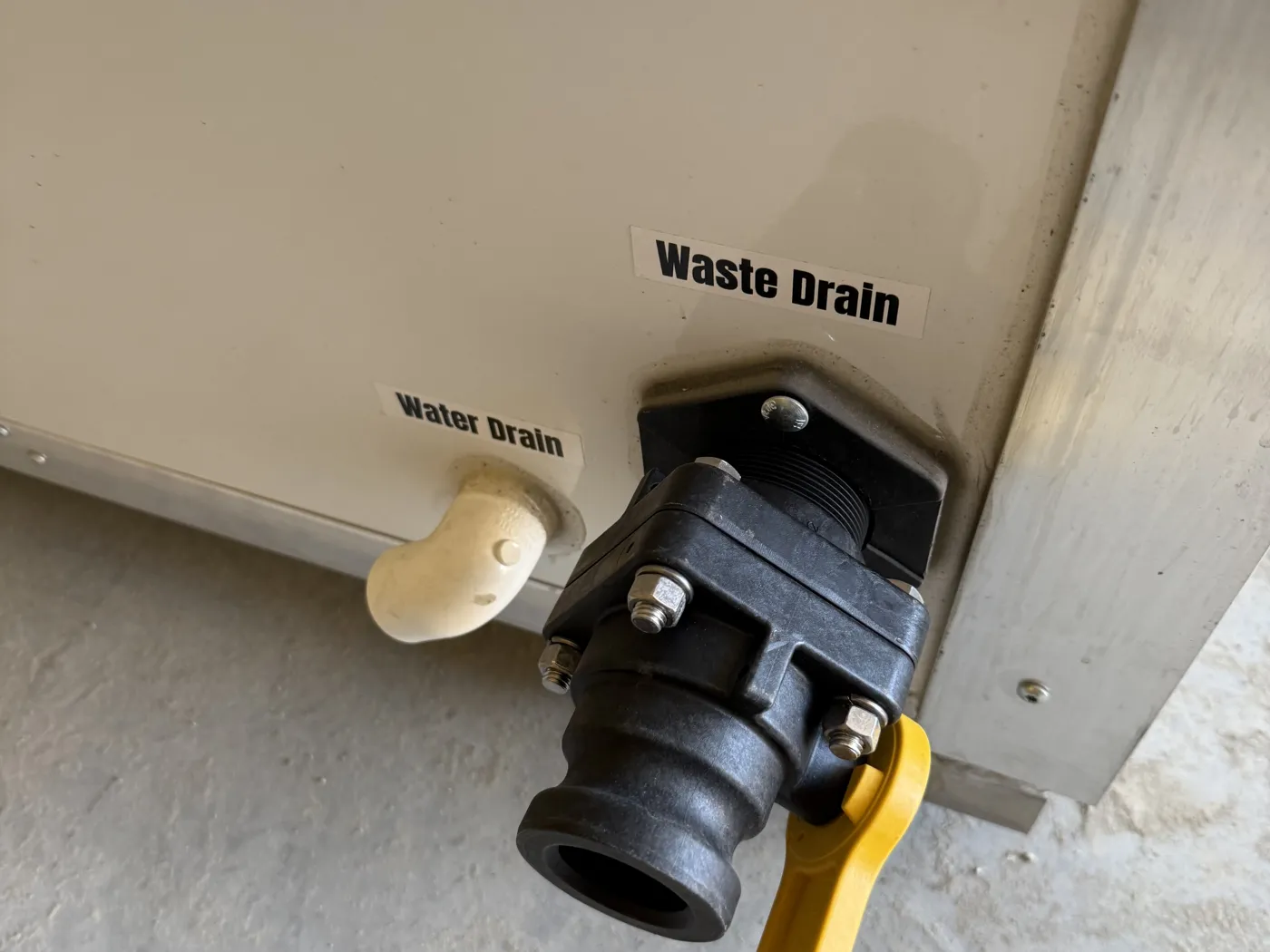
- 7 Service ports. Our truck refills water through a 1-inch cam lock fill port and pumps waste through a 2-inch cam lock drain — same side of the box, one visit.
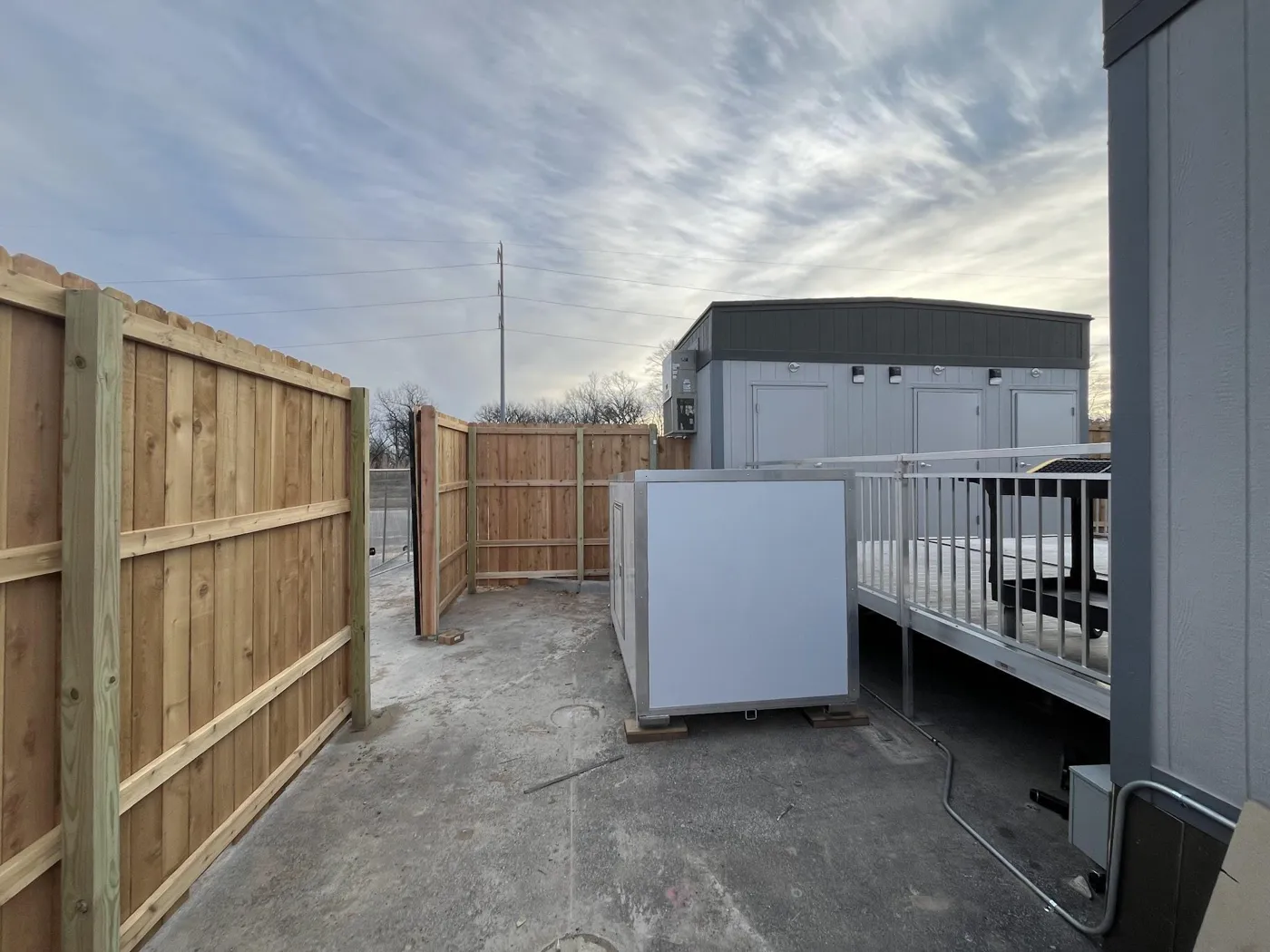
Diagram shows a Complete Box (water + waste). A Water Box has the fresh water side only, with two tanks. A Waste Box has the waste side only, with two tanks.
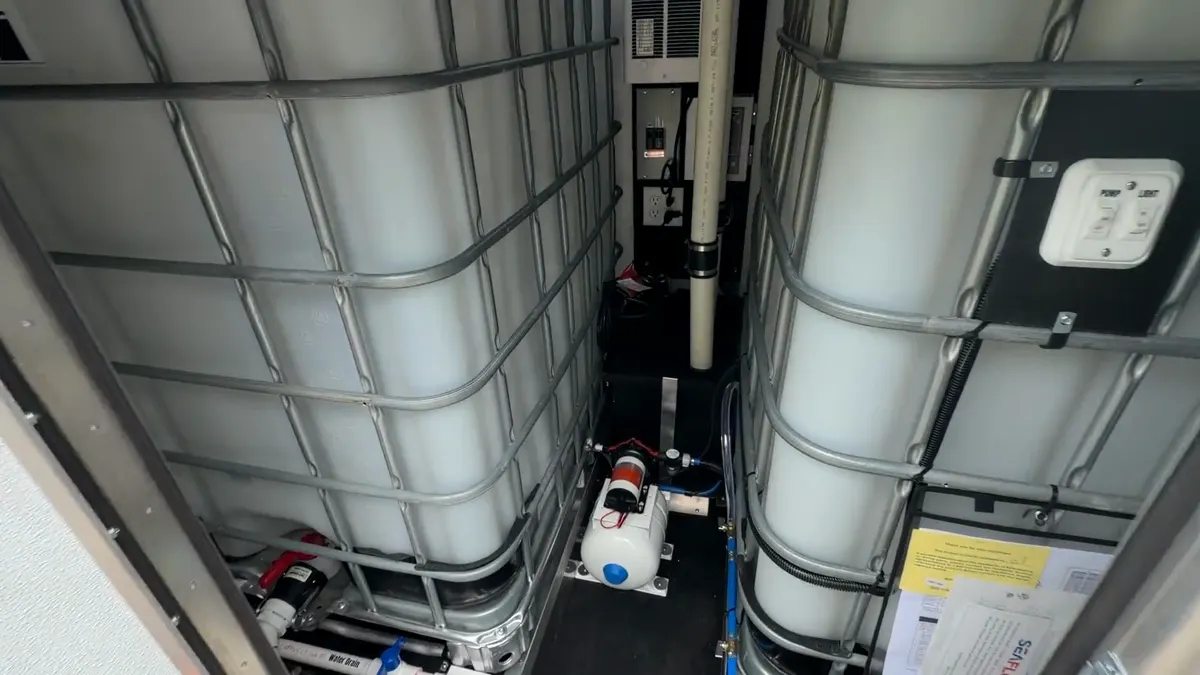
Three Models
Water Box
660 gal fresh water
- Dual 330-gallon tanks inside an insulated, heated box
- Moro DC-10 12V pump, ~20 GPM, 20-gallon pressure tank
- Deep-cycle battery runs the pump through a power drop
- Float valve dry-run protection
- Daisy-chain up to 3 units (1,980 gal)
Use when: The site has sewer or a separate waste plan, but no city water. Also feeds restroom and shower trailers.
Full specs →Waste Box
660 gal waste holding
- Dual 330-gallon tanks inside an insulated, heated box
- Dual sewage pumps — automatic backup
- High-level alarms in sump basins and tank
- 3" inlet from trailer, 2" cam lock pump-out
- Daisy-chain up to 3 units (1,980 gal)
Use when: The site has water but no sewer, or crew size needs more waste capacity than a Complete Box holds.
Full specs →Complete Box
270 gal fresh + 330 gal waste
- One fresh tank and one waste tank inside an insulated, heated box
- 12V water pump with pressure tank
- Sewage pump in sump basin, high-level alarms
- Water fill and waste pump-out on the same side
- One box, one forklift pick, one service visit
Use when: A single office trailer with no water and no sewer.
Full specs →Complete Box cut sheet (PDF)Plan and elevation views, connection locations, full specs. 8'-0" x 5'-0" x 5'-0". For submittals and site logistics plans.
Need more capacity? Water Boxes and Waste Boxes daisy-chain, up to 3 units and 1,980 gallons. See how chaining works ↓
Daisy-Chain for More Capacity
Water Boxes and Waste Boxes are purpose-built to link together. Up to 3 boxes connect through cam lock fittings on each box and work as one system. That is why the dedicated boxes carry more pump than a single office trailer needs.
Up to 3 boxes act as one 1,980-gallon supply. One box can feed several trailers at once.
- Two pump types and a 20-gallon pressure tank in each box: a high-flow pump (~20 GPM) moves a lot of water fast, and demand pumping holds steady pressure at the fixtures.
- Feeds several restroom or shower trailers continuously from one connection point. Rated to run two 8-stall shower trailers at once.
- Moves 100 gallons in about 10 minutes, so it also works as a fast-fill station for trailer tanks.
Up to 3 boxes act as one 1,980-gallon holding system. Three times the waste between pump-outs.
- Dual sewage pumps in each box. The second pump takes over automatically.
- High-level alarms in the sump basins and the tanks warn before anything backs up.
- Three boxes manage three times the waste of one, for large crews, multiple trailers, or longer stretches between pump-outs.
| Chained | Fresh water (Water Box) | Waste holding (Waste Box) |
|---|---|---|
| 1 box | 660 gal | 660 gal |
| 2 boxes | 1,320 gal | 1,320 gal |
| 3 boxes | 1,980 gal | 1,980 gal |
When to chain: Crews above roughly a dozen people, more than one trailer on the same system, restroom or shower trailers alongside the office, or sites where the service truck cannot come more than once a week.
Site planning: Each box is 8 ft x 5 ft and needs its own level spot, set side by side. Each box needs its own dedicated 120V / 20A circuit for its heater and pumps.
Box vs. Open Tote and Under-Trailer Tank
The usual setup for an office trailer without hookups is an open water tote next to the trailer and a low-profile waste tank slid under the floor. Both sit in the weather. Here is how that compares.
| Stahla Water / Waste / Complete Box | Typical open water tote | Typical under-trailer waste tank | |
|---|---|---|---|
| Enclosure | Insulated, fully enclosed box with a lockable door | Open cage tote, exposed to weather and sun | Exposed under the trailer floor |
| Freeze protection | 1,000W electric heater inside the box; heated hose and heat-traced, insulated waste line at install | None built in. Add-on blankets or heat tape, if any | None built in. Relies on skirting and whatever heat leaks from the floor |
| Water pressure | Built-in pump and pressure tank — steady pressure at sinks and toilets | No pump. Gravity feed or a separate pump set up on site | Not applicable |
| Waste handling | Sewage pump lifts waste into a sealed, vented tank. Trailer sits at normal height | Not applicable | Gravity drain only. Tank height limits slope; trailer may need to be set higher |
| Warning before a problem | High-level alarms (light + beeper) and power-loss alarm | None — you find out when the faucet stops | None — you find out when it backs up |
| Capacity | 660 gal water, 660 gal waste, or 270 + 330 combined. Daisy-chain to 1,980 gal | One tote at a time | Limited by what fits under the floor |
| Security and appearance | Locked. Tanks, valves, and cords out of sight | Open to tampering and contamination | Hidden, but fittings exposed |
| Servicing | Water fill and waste pump-out from outside ports, same side. Refill and pump-out in one weekly visit, with a system check | Separate water delivery | Separate pump-out. Driver works under the trailer |
| Moving it | Fork pockets — relocates with a forklift as the site changes (emptied first) | Forklift | Must be emptied and pulled from under the trailer |
"Typical" describes common rental setups; individual providers vary. Ask any provider how their tanks are protected below 32°F.
Prepare Your Site
Plan these before the trailer is set. Power and placement are the two things that are hard to change once the trailer lands.
What your site needs
- A level, firm spot beside the trailer: Gravel or pavement. Every box is 8 ft x 5 ft and 5 ft tall. Set it on the side of the trailer closest to the restroom plumbing. The shorter the waste run, the easier it is to hold slope and keep it warm. We level the box on blocks.
- A forklift or skid loader with forks: The box has fork pockets — no axles or hitch. If you have a machine on site, we use it. If not, tell us and we plan the offload.
- One dedicated 120V / 20A circuit: Powers the heater and pumps. Dedicated means nothing else on that breaker. Within 50 ft of the box.
- An outdoor GFCI outlet at the trailer: For the heated water hose and the heat cable on the waste line. Most office trailers have one under the frame.
- Temporary or generator power that stays on: Nights, weekends, and holidays included. If the site runs on a generator, size it for the extra 1,000W heater load and keep it fueled.
- A clear lane for the service truck: The truck needs to reach the port side of the box every week. Keep it clear of snow piles, material laydown, and parked equipment.
- Trailer skirting in winter: Skirting protects the trailer's own plumbing and the first few feet of the waste line.
- Tell us crew size and schedule: Headcount, days per week, and how many restrooms are in the trailer. That sets the model and the service frequency.
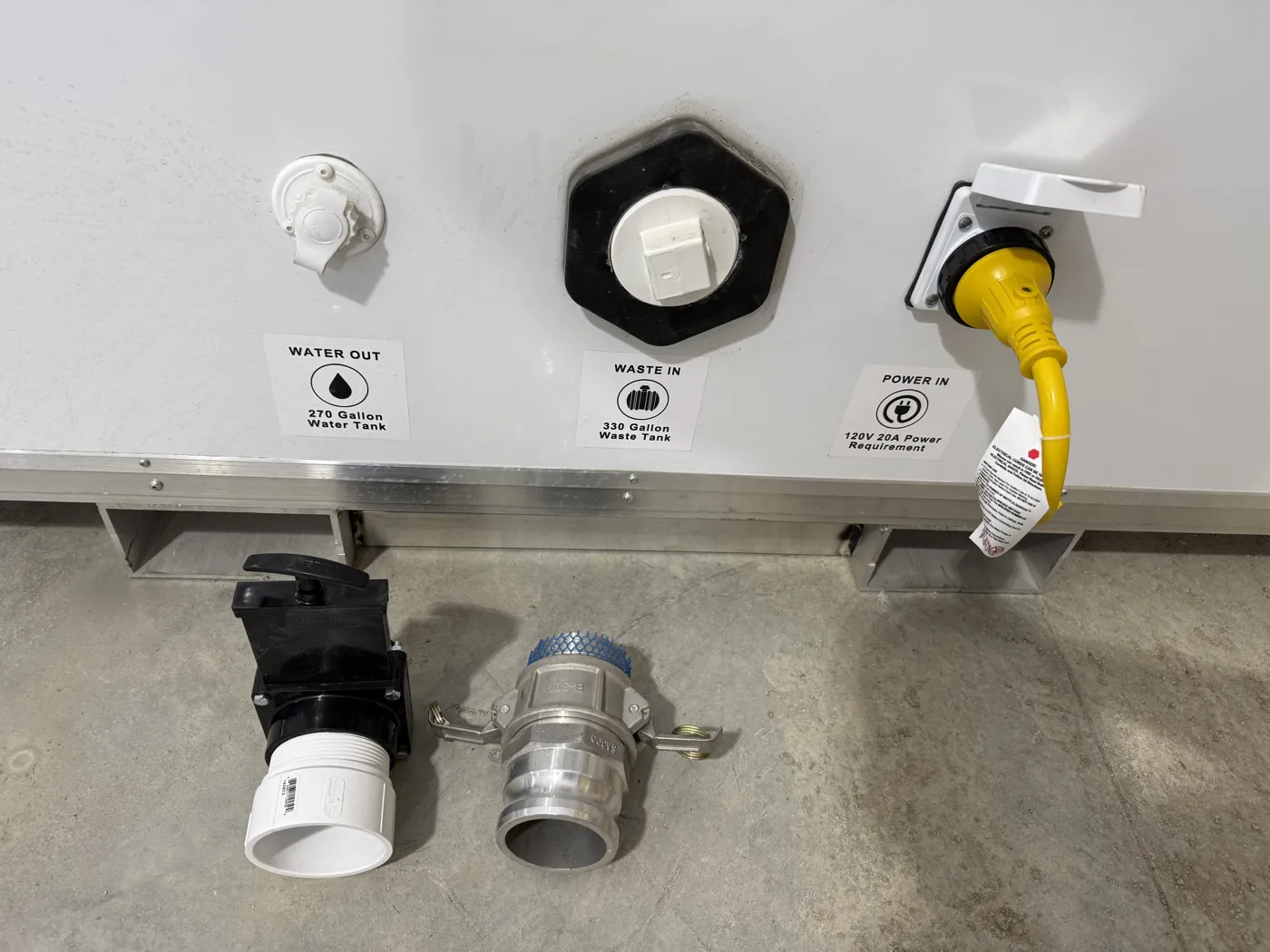
Three connections face the trailer, each labeled: Water Out, Waste In, Power In (120V / 20A).
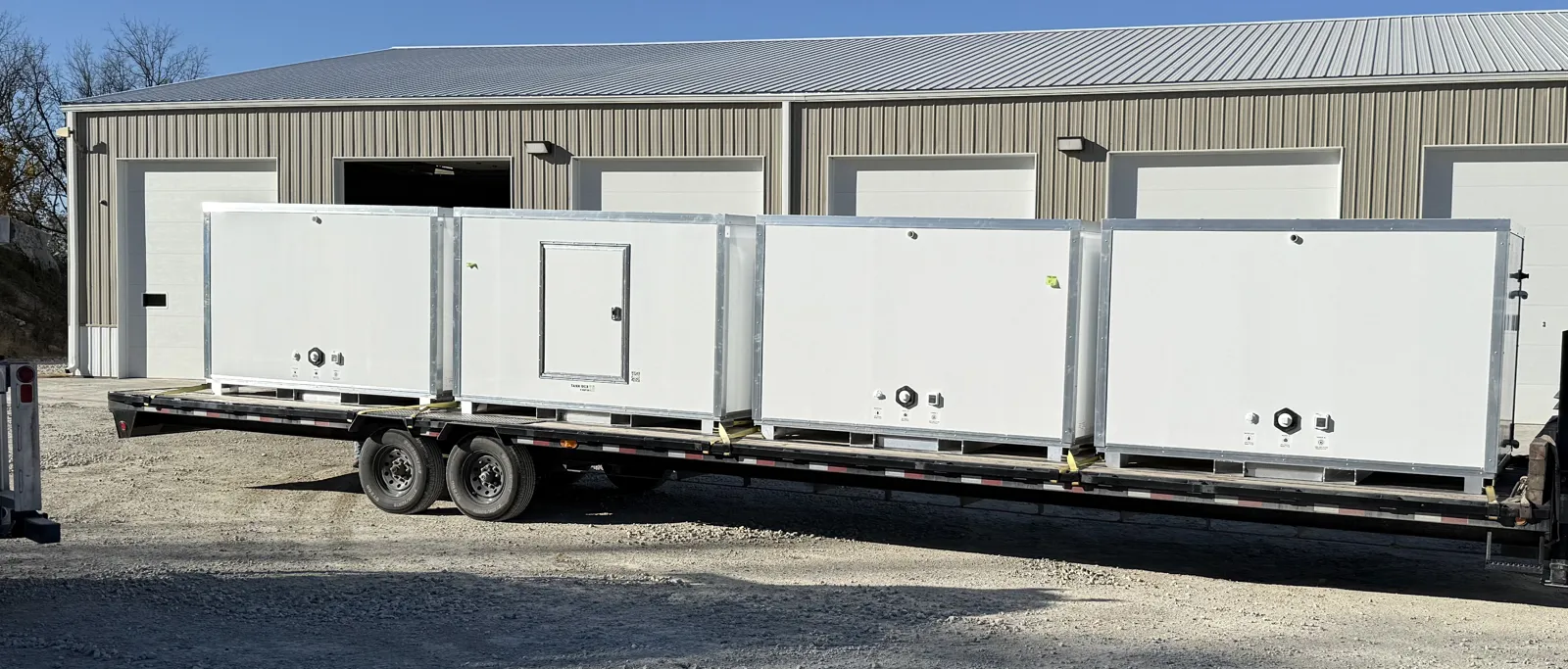
How it arrives: on a flatbed, lifted off by forklift and set beside your trailer.
What we do at install
- 1Place the box by forklift and level it on blocks.
- 2Plumb the trailer drain to the 3-inch waste inlet with a 1/4 inch per foot slope toward the box.
- 3Connect the heated hose from the box to the trailer water inlet and sleeve it in foam insulation.
- 4Wrap the waste line in heat cable and insulation, then tape it against wind and moisture. Thermostats stay exposed to outside air so they cycle correctly.
- 5Connect power, fill the fresh tank, and test: water pressure at the fixtures, sewage pump, heater, and alarms.
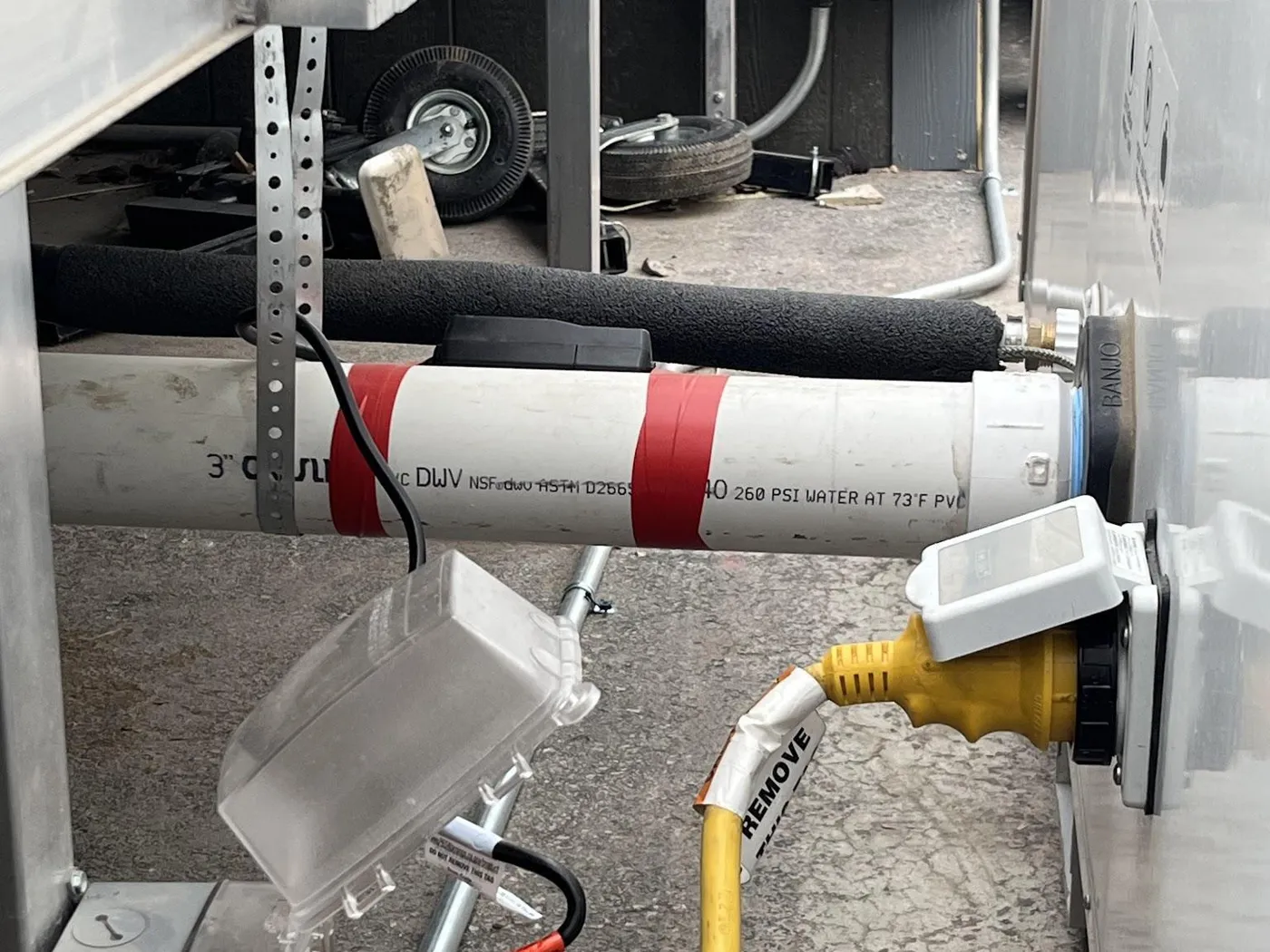
A finished hookup: insulated water line (top), 3-inch waste line with heat cable, and the power cord to a covered outlet.
Servicing
The box is only as good as the route behind it. Servicing is part of the rental — one vendor for the equipment and the truck.
Every weekly visit
- Refill fresh water to the overflow indicator
- Pump out the waste tank
- Water and waste in the same stop on Complete Boxes
System check
- Heater running, box interior warm
- Water pump pressure and strainer
- Sewage pump and alarms
- Heated hose and heat-traced waste line
- In extreme cold: interior drain valve closed after pump-out so the outside drain line stays empty
Between visits
- Service frequency matched to crew size — more than weekly when the headcount needs it
- Questions or a service call between visits: (844) 900-3190
- Pump or part failure: modular pump plate swaps in the field
Winter
Freeze protection is layered. The box protects the tanks and pumps. The install protects the lines between the box and the trailer. Your site keeps the power on.
What protects the system
- Insulated, enclosed box — tanks, pumps, and valves are never in the wind.
- 1,000W electric heater inside the box.
- Heated, insulated hose for fresh water between box and trailer.
- Heat cable, insulation, and tape on the waste line between trailer and box.
- Interior drain valve isolates the exterior pump-out line so nothing sits in it and freezes.
- Power-loss alarm — red light and beeper when the circuit drops.
- Weekly eyes on the system from the service driver.
What we ask of your crew
- Keep the box circuit powered 24/7. Do not unplug it or share the breaker.
- Keep the box door closed and latched.
- Do not bury the hose or heat cable thermostats under insulation, snow, or material.
- Keep the service lane plowed to the port side of the box.
- If an alarm sounds, call (844) 900-3190.
- Tell us before the trailer is moved or power is shut down for a holiday.
Frequently Asked Questions
Get a Quote Before the Ground Freezes
Tell us your site location, crew size, and when the trailer is set. We will size the box, confirm the service schedule, and quote within 4 hours.
- ✓ Delivered, placed, and connected
- ✓ Winter install: heated hose, heat-traced waste line
- ✓ Weekly water refill and waste pump-out
- ✓ One invoice, one vendor
Or call (844) 900-3190.
Get a Free Quote
Loading form…
Setting a Trailer This Winter?
Plan water and waste before the trailer lands. We will walk through placement, power, and service schedule with you.